reflect
reflect is a Claude Code plugin — it is loaded by Claude Code (Anthropic’s plugin system: skills + hooks + commands), not by the ainb TUI. It captures the corrections and design decisions you make in a session as structured learnings, indexes them into a hybrid GraphRAG + BM25 knowledge base, and auto-injects the most relevant prior learnings into every new session. Philosophy: correct once, never again; recall everything next time. Current version: 3.6.0.
How it works
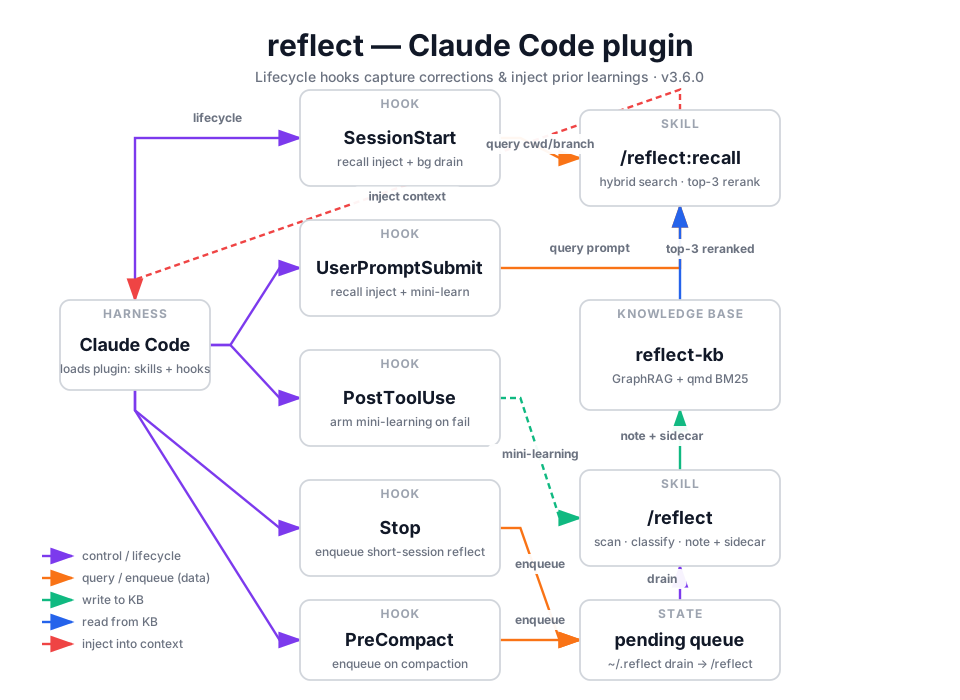
The plugin manifest registers five lifecycle hooks. SessionStart runs two commands: session_start_recall.py builds a query from the session’s cwd, branch, and recent commits and injects the top-3 reranked learnings as additionalContext; and reflect-drain-bg.sh launches a detached background drainer that processes any reflections queued from prior sessions. UserPromptSubmit re-runs recall using the actual prompt as a sharper query (with per-session dedupe), and also completes the mini-learning capture — if a tool just failed and the prompt looks like a correction, it writes a low-confidence learning straight to disk without spending an LLM call.
PostToolUse is the first half of that cheap capture path: when a tool call fails, it arms a watcher so the next UserPromptSubmit can detect a correction. Stop enqueues short sessions (that ended before compaction) for asynchronous reflection, and PreCompact enqueues long sessions when Claude Code compacts the conversation — both feed the same ~/.reflect/pending_reflections.jsonl queue, deduped by session_id.
Capture and indexing run through the sub-skills. /reflect scans a conversation, classifies corrections vs. successes, and writes a Markdown learning note plus a YAML entity sidecar (people, files, libraries, decisions). The background drainer replays queued transcripts through the same /reflect skill headlessly. Everything is dual-indexed into reflect-kb — nano-graphrag for semantic + entity-graph search and qmd for fast BM25 lexical search — both running locally.
Retrieval closes the loop: /reflect:recall (the same engine the SessionStart and UserPromptSubmit hooks call automatically) runs hybrid search, reranks by confidence × recency × tag overlap, and surfaces the strongest learnings back into the agent’s context before the first token is generated.
What it provides
Skills
| Skill | Purpose |
|---|---|
reflect | Full conversation scan — detect behavioral corrections and knowledge signals, classify them, write a learning note with an entity sidecar for GraphRAG indexing |
reflect:recall | Retrieve relevant prior learnings from the global KB via hybrid vector + graph search, reranked by confidence, recency, and tag overlap (also runs automatically at SessionStart / UserPromptSubmit) |
reflect:ingest | The global knowledge indexer — harvest ALL memory sources across tools (Claude, Codex, Copilot, Gemini) into the unified GraphRAG + qmd KB, archiving originals and generating entity sidecars |
reflect:consolidate | Project-level memory consolidation — merge orphaned worktree memory dirs into a single .agents/MEMORY.md (deduplicates and sections; does not index into the global KB) |
reflect:errors-ack | Triage and acknowledge entries in the reflect errors sink (~/.reflect/errors.json) — drain poison, parser crashes, ingest failures, hook timeouts; invoked from the statusline ⚠N badge |
reflect-status | Read-only metrics — pending reviews, sidecar coverage, GraphRAG health; can approve/reject pending low-confidence items |
Hooks (registered in plugin.json)
| Event | What fires |
|---|---|
SessionStart | session_start_recall.py injects top-3 learnings from cwd/branch/commits, plus a detached reflect-drain-bg.sh that drains the pending-reflections queue in the background |
UserPromptSubmit | user_prompt_submit_recall.py re-runs recall against the actual prompt (deduped) and writes a mini-learning if a prior tool failure is being corrected |
PostToolUse | posttooluse_minilearning.py arms a mini-learning watcher when a tool call fails (cheap, no LLM call) |
Stop | stop_reflect.py enqueues short sessions for asynchronous reflection, deduped against PreCompact |
PreCompact | precompact_reflect.py --auto --verbose enqueues the transcript for reflection when Claude Code compacts the conversation |
Install
Reflect is two layers: the plugin (hooks + skills) and the reflect-kb CLI (recall/search + qmd + nano-graphrag). Both now ship from the standalone stevengonsalvez/ainb-reflect-memory repo (the CLI flattened at the repo root, the plugin under plugin/) — they are no longer in the agents-in-a-box monorepo, so claude plugin install reflect@agents-in-a-box no longer resolves. The one-step path uses ainb:
# 1. CLI engine (recall/search + qmd + nano-graphrag) — no subdirectory:uv tool install --upgrade 'git+https://github.com/stevengonsalvez/ainb-reflect-memory.git[graph]'
# 2. plugin: skills + hooks — install NATIVELY per harness from the new repo's#    plugin/ dir (distinct manifests, no conflict). Install per your harness's#    plugin runtime / the adapters under plugin/adapters/ (see the repo README).
# 3. everything else in one shot — `ainb reflect bootstrap` auto-installs the#    reflect-kb[graph] engine via uv (from the new repo URL above) and prints#    any missing system tools (bash>=4, coreutils, jq) for you to runainb reflect bootstrap
# 4. verify — dependency check classified by what needs each toolainb doctor
ainb reflect bootstrap is hybrid: it auto-installs the reflect-owned layer (reflect-kb[graph], now from ainb-reflect-memory) and only prints the brew/apt commands for system tools, so it never mutates your OS or PATH. The manual equivalent (with annotated commands + the nano-graphrag --no-deps caveat) lives in the ainb-reflect-memory plugin README.
One plugin dir, three native installs
All three harnesses have native plugin runtimes, and the new repo’s plugin/ dir is a valid plugin for each — the manifests live at distinct paths and reference distinct hooks files, so they coexist without conflict:
| Harness | Manifest | Hooks file | Hook shape | Install |
|---|---|---|---|---|
| Claude Code | .claude-plugin/plugin.json | inline in manifest | PascalCase, ${CLAUDE_PLUGIN_ROOT} | from the ainb-reflect-memory plugin/ dir |
| GitHub Copilot | plugin.json (root) | copilot-hooks.json | camelCase + version:1, ${PLUGIN_ROOT} | copilot plugin install installs skills; hooks via adapter until Copilot plugin hook support ships |
| OpenAI Codex | .codex-plugin/plugin.json | codex-hooks.json | PascalCase, ${PLUGIN_ROOT} | from the ainb-reflect-memory plugin/ dir |
(All paths above are relative to the new repo’s plugin/ directory.) Shared (read-only) across all three: skills/, hooks/ scripts, scripts/. No default-discovery hooks file (hooks.json / hooks/hooks.json) exists, so no harness auto-loads the wrong-format file.
Hook status per harness:
- Claude Code: hooks registered via
.claude-plugin/plugin.json— fully auto-wired when the plugin is installed. - GitHub Copilot:
plugin.jsonhooksfield is scaffolded for future use; Copilot’s plugin system currently installs skills only (hooks listed as “coming soon” in thegithub/copilot-pluginsmarketplace). Hooks are wired via the Python adapter (adapters/copilot/copilot_adapter.py install), which writes~/.copilot/hooks/reflect.jsonwith the correctversion:1camelCase format. Once Copilot ships hook support, thecopilot-hooks.jsonand${PLUGIN_ROOT}will be used automatically. - OpenAI Codex: hooks registered via
.codex-plugin/plugin.json— auto-wired on install.
Copilot does not auto-inject sessionStart additionalContext into the model context in headless -p mode, so on Copilot recall is surfaced via manual /recall.
Using it
- Mostly automatic. Once installed, the SessionStart hook fires
recallat the start of every new session and surfaces relevant prior learnings before you type. UserPromptSubmit sharpens that with the actual prompt on each turn. - Capture happens for free. Failed tool calls + correction-shaped follow-ups become low-cost mini-learnings, and short / compacted sessions are queued and drained in the background — no manual step required.
/reflect— run it explicitly to scan the current conversation and write a learning note when you want to capture something deliberately./reflect:recall "<anything>"— query the knowledge base on demand./reflect:ingest— periodically bulk-index existing memories from any tool into the global KB./reflect:consolidate— merge scattered worktree memory dirs into one project.agents/MEMORY.md./reflect-status— view pipeline metrics, pending reviews, and KB health; approve/reject low-confidence items./reflect:errors-ack— triage the errors sink when the statusline shows a ⚠N badge.
Memory browser
The knowledge base this plugin captures into and recalls from can also be browsed, searched, and
curated from a local web app — reflect serve, part of the reflect-kb engine. It reads the same
markdown KB the plugin writes to, so archiving or editing confidence there is visible on the next
recall (after a reflect reindex). See the
memory browser guide for how to run it.
Source
stevengonsalvez/ainb-reflect-memory — Claude Code plugin (skills + lifecycle hooks, under plugin/) backed by the reflect-kb GraphRAG + qmd library (flattened at the repo root). Extracted out of the agents-in-a-box monorepo into its own repo. Diagram generated via /fireworks-tech-graph.