session-reader plugin
A pure data-plane plugin: it owns no screen and no CLI namespace. It walks the per-provider session-log directories, aggregates a UsageData snapshot, and chunk-publishes it on the sessions.usage_data topic for downstream consumers (burndown, and the host) to render. It is the canonical publisher example — the inverse of a screen-owning plugin, exercising only the event bus, log-read, and plugin-data capabilities.
How it works
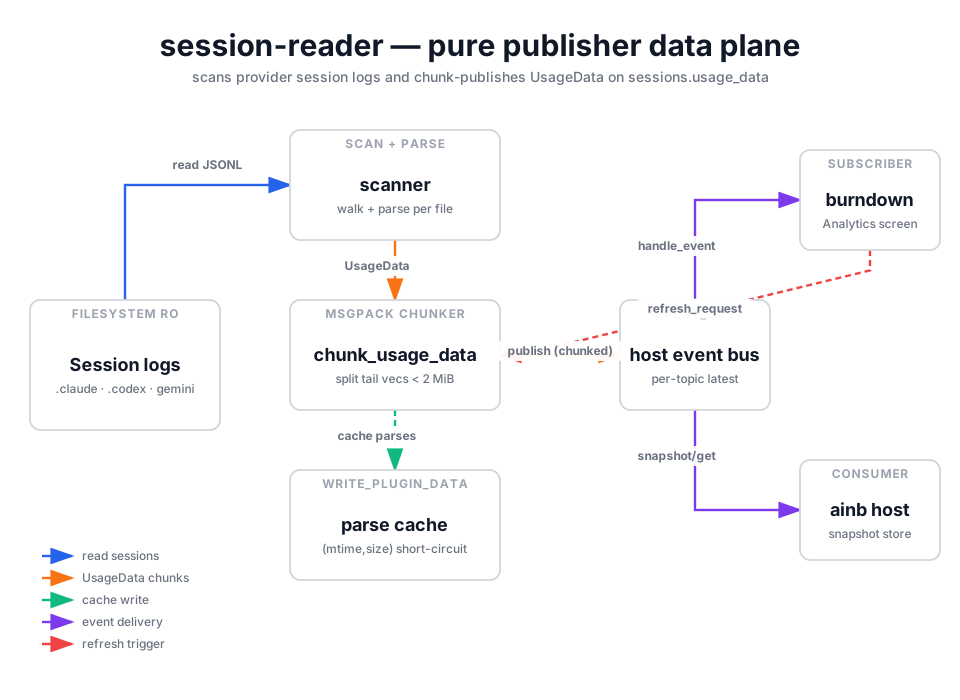
The plugin never paints anything — its Plugin::render returns an empty 0×0 WireBuffer and the host’s render path tolerates that. On plugin/init it does not publish; instead it subscribes (host/snapshot/subscribe) to two trigger topics and then sits idle. Publishing on startup would race the consumer’s own subscription and lose chunks, so the design is strictly pull: a consumer asks, the plugin answers.
When a plugin/handle_event for sessions.refresh_request arrives, the plugin scans the four provider roots (~/.claude/projects/**, ~/.codex/sessions/**, ~/.gemini/sessions, ~/.config/github-copilot/sessions, plus Cursor) on a blocking task, parses each file, and aggregates a UsageData snapshot. Parses are cached in a SQLite file under the plugin’s own data dir — files whose (mtime, size) are unchanged short-circuit, so a warm rescan is cheap. While the cold scan runs it streams per-file progress on sessions.scan_progress so burndown can render a “Scanning sessions…” line.
The aggregated UsageData is then split by chunk_usage_data into one or more msgpack envelopes, each kept under ~2 MiB so the post-base64 JSON-RPC body stays well under the host framer’s 16 MiB cap. Chunk 0 carries the bounded aggregates; follow-on chunks carry slices of the unbounded tail vecs (calls, sessions, shell_commands); the last chunk is flagged is_final. Each chunk is pushed via host/snapshot/publish on sessions.usage_data.
The host’s event bus stores the latest publish per topic and fans plugin/handle_event deliveries to subscribers (burndown); the host itself can also pull the stored snapshot via host/snapshot/get. The sessions.flush_cache_request topic is the recovery escape hatch — it wipes the parse cache and forces a cold rescan (driven by burndown’s F key).
Capabilities
These are the exact [capabilities] from manifest.toml. Every flag defaults to deny; the plugin grants only what its data plane needs.
| Capability | Value | Why it’s needed |
|---|---|---|
read_claude_logs | true | Read ~/.claude/projects/**/*.jsonl session histories. |
read_codex_logs | true | Read ~/.codex/sessions/** rollout logs (also covers the Gemini/Copilot/Cursor roots the scanner walks). |
event_bus | true | Subscribe to trigger topics and publish the snapshot + progress on the bus. |
write_plugin_data | true | Persist the SQLite parse cache under the plugin’s own data dir for warm rescans. |
network | [] | No network access. |
spawn_subprocess | false | No child processes. |
Using it
There is nothing to open and nothing to type — by design. The plugin provides no screen, no slash command, and no ainb <ns> ... CLI namespace. You interact with it only indirectly, through the topics it publishes and subscribes:
- Publishes (
[provides] snapshots):sessions.usage_data— the chunkedUsageDatasnapshot consumed byburndown(and the host). It also publishessessions.scan_progresswhile a cold scan is in flight. - Subscribes (
[subscribes] snapshots):sessions.refresh_request(any publisher forces a re-scan + re-publish) andsessions.flush_cache_request(wipe the parse cache, then cold re-scan — backingburndown’sFkey). - Lifecycle: declared
spawn = "eager"so the first snapshot is ready beforeburndownasks; idle-reaped after 600s.
To see its output, open the Analytics screen owned by burndown (or run ainb usage) — that screen renders the snapshot this plugin produces.
Source
crates/ainb-plugin-session-reader — the data backend for ainb’s usage analytics: scans provider session logs, caches parses, and chunk-publishes the UsageData snapshot. Diagram generated via /fireworks-tech-graph.