witr plugin
witr surfaces process-causality tracing inside ainb by wrapping the external witr binary (>= 0.3.2 on PATH). It is the canonical subprocess-wrapping reference — and it exemplifies two integration patterns at once: a host-embedded foreign TTY for its interactive screen, and a spawn_subprocess exec-and-parse flow for its CLI and slash command.
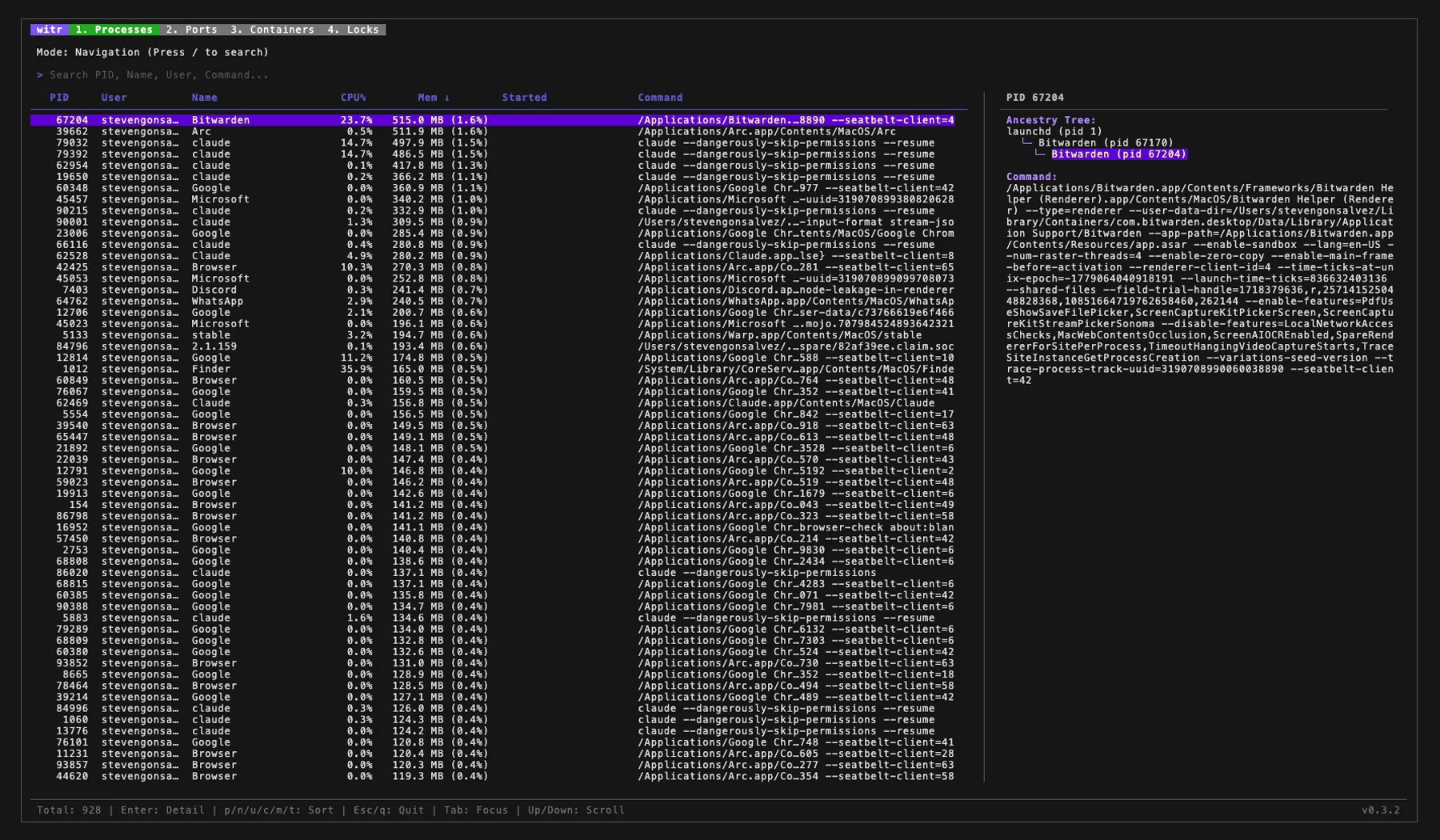
Press w in ainb to open witr’s interactive browser full-screen — a sortable all-process list with a live ancestry pane.
How it works
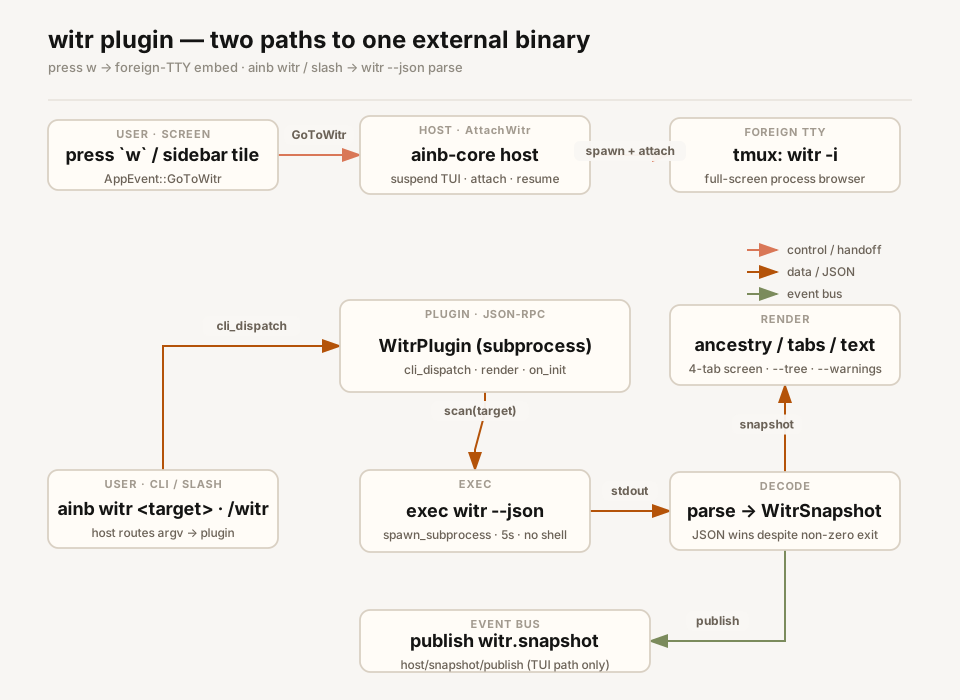
There is no single render path here — witr is two surfaces fused onto one external binary, and the diagram shows them as two lanes.
The screen is not a WireBuffer. witr’s value is its own interactive all-process browser (sortable process list + ancestry pane), which has no machine-readable render — it lives only in witr -i. So pressing w (or the sidebar tile) does a host-level handoff, not a plugin/render call. The host (ainb-core) emits AppEvent::GoToWitr, which queues AsyncAction::AttachWitr: ainb runs tmux new-session -A -d -s ainb-witr "witr -i", suspends its own TUI, and attaches full-screen to witr’s native interactive browser — the same suspend/attach/resume mechanism ainb uses to embed agent sessions. When the user quits witr, ainb resumes. This wiring lives entirely in ainb-core; the plugin’s render is never invoked for the screen.
The CLI and slash run witr --json and parse it. ainb witr <target> is routed by the host to the plugin’s plugin/cli_dispatch (namespace witr); /witr <target> reaches handle_slash. Both call the plugin’s single scan() authority, which execs witr --json <target> under the spawn_subprocess capability (argv array, no shell; bounded by a 5s timeout) and decodes stdout into a typed WitrSnapshot. The decode tolerates two real witr quirks: witr exits non-zero to signal that warnings are present even when it printed a complete, valid JSON snapshot — so a successful parse wins regardless of exit code — and Go’s encoding/json marshals empty slices/maps as null, which is mapped back to empty collections. From the snapshot, the CLI emits text / --tree / --warnings / canonical --format json, while the slash opens a detail overlay.
Fresh scans publish on the event bus. When a scan runs from a live host channel (the TUI refresh path), the parsed snapshot is published to the witr.snapshot topic via host/snapshot/publish, msgpack-encoded and byte-deterministic. The one-shot ainb witr CLI invocation passes no host channel — there are no bus subscribers during a single CLI run — so the publish is skipped there.
Capabilities
These are the exact non-default capabilities declared in manifest.toml. Every other capability (read_sessions, read_claude_logs, read_codex_logs, write_plugin_data, network) is left at its deny default.
| Capability | Declared value | Why it is needed |
|---|---|---|
spawn_subprocess | ["witr"] | Exec witr --version (detect on init) and witr --json <target> (every scan). The list form is per-binary audit metadata. |
event_bus | true | Publish each fresh scan on the witr.snapshot topic via host/snapshot/publish. |
Using it
- Screen — open it by pressing
wfrom the home surface or selecting the witr sidebar tile. Instead of a plugin-rendered screen, ainb hands the terminal to witr’s nativewitr -iinteractive browser full-screen (sortable all-process list + ancestry pane); quit witr to return to ainb. If witr is missing or below 0.3.2, the plugin renders an install/upgrade empty state instead. - CLI (
cli_namespaces = ["witr"]) —ainb witrexecs the wrapped binary and renders the parsed snapshot:ainb witr nginx— trace a process by name (positional; witr fuzzy-matches)ainb witr --pid 1234,ainb witr --port 5432,ainb witr --file /var/run/x.lock,ainb witr --container redis— typed targetsainb witr nginx --tree— ancestry chain as an indented treeainb witr --port 5432 --warnings— just the warnings listainb witr --pid 1234 --format json— canonical JSON re-emit of the snapshotainb witr nginx --short— rawwitr <target>passthrough (no JSON re-parse; cannot be combined with--format json)
- Slash command (
/witr) —/witr <target>scans the target and opens a focused detail overlay over the current screen. - Published topic —
witr.snapshot(msgpack-encodedWitrSnapshot), emitted on each fresh scan from a live host channel. The plugin subscribes to nothing.
Source
crates/ainb-plugin-witr — detects the external witr binary, owns the ainb witr CLI + /witr slash via witr --json exec-and-parse, publishes witr.snapshot, and renders the missing/outdated empty state; the foreign-TTY screen handoff (w → witr -i) is wired in ainb-core. Diagram generated via /fireworks-tech-graph.