ainb-fleet
ainb-fleet (v0.1.0) is a Claude Code plugin — loaded by Claude Code itself, not by the ainb TUI — that ships a bundle of LLM-facing skills teaching an agent how to use the ainb fleet ... orchestration subcommands: broadcasting a prompt to many sessions, ack-gated step sequences, surfacing blocked sessions (“needs”), an auto-continue daemon, and a fleet standup. The orchestration logic itself lives in the ainb Rust binary; this plugin is purely the teaching layer that points the agent at the right command for the job. It replaces the deprecated popa plugin, whose Node code is gone.
How it works
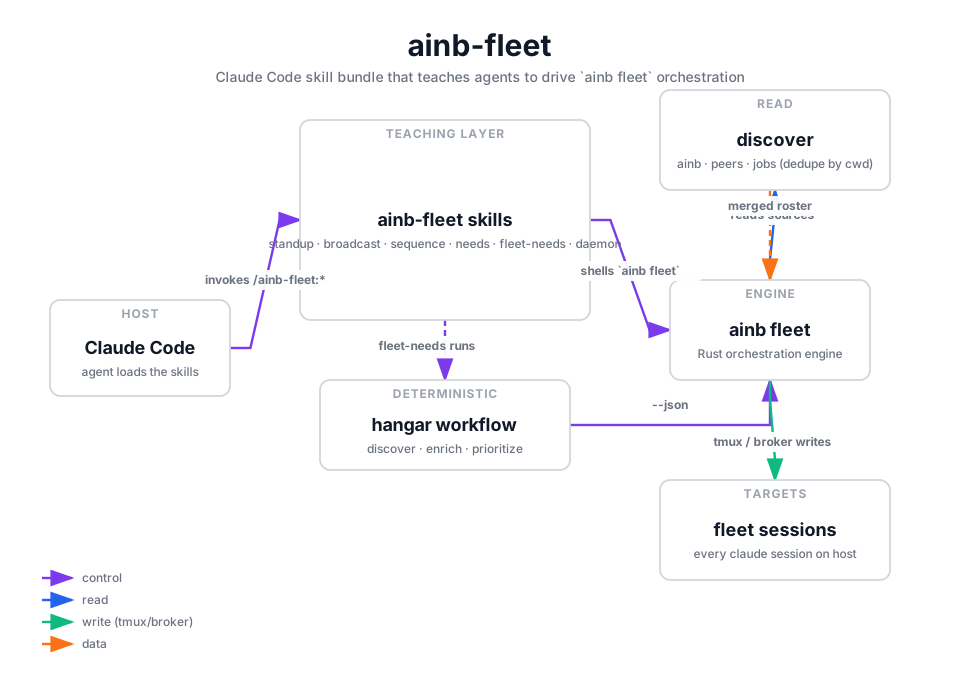
This plugin registers no hooks, no commands, and no agents — it is a pure skill bundle. When you invoke one of its colon-namespaced skills (/ainb-fleet:standup, /ainb-fleet:broadcast, etc.), the skill teaches the agent the exact ainb fleet ... invocation to shell out to. All the real work — discovering sessions, reading transcripts, routing writes — happens inside the ainb Rust binary.
The fleet engine discovers sessions from three sources — every session ainb has spawned, sessions registered with the claude-peers broker (~/.claude-peers.db), and background-job dirs under ~/.claude/jobs/ — then merges and dedupes them by cwd. Reads go through the source of truth (JSONL transcripts plus tmux pane buffers); writes go out peers-first via the broker when a peer is registered, falling back to tmux send-keys literal mode otherwise.
The bundle has a top-level router skill (ainb-fleet) that maps the five verbs to their focused sub-skills, plus a workflow-backed variant of needs. The fleet-needs skill runs the deterministic hangar workflow (verb=needs: discover → enrich → prioritize → render-ready cards), then renders a “Jarvis HUD” of every blocked session and fires an AskUserQuestion per session so the user can answer the whole fleet in one batch; answers are routed back to each target’s tmux pane.
The daemon skill describes a long-running watcher that scans each session’s recent pane buffer every 5 seconds and auto-sends continue to any session whose buffer matches a known API-error regex (rate_limited, overloaded_error, internal_server_error, request_timeout, socket_hang_up, fetch_failed, connection_reset), deduping on (session_id, pattern, match-context) so it fires once per error.
ATC (Air Traffic Control) is the persistent orchestrating brain that ties the verbs together on a schedule with a policy. ainb fleet atc setup <name> provisions ~/.agents-in-a-box/atc/<name>/ — a generated CLAUDE.md policy, a meta.json config, seeded state.json / task-log.md durable memory, and an installed OS-timer heartbeat (launchd StartInterval on macOS, a systemd --user timer on Linux) — then spawns a real ainb run Claude session reading that policy. Every N minutes (default 15) the timer runs ainb fleet atc heartbeat <name>, which builds a compact [HEARTBEAT] nudge from the LLM-free ainb fleet needs --format json read and tmux-sends it into the session, so ATC spends tokens only deciding. The policy is conservative and escalate-on-uncertainty: it auto-clears the safe cases (confident ASK → broadcast; ERR → continue, capped at 3 per session) and escalates the rest to the phone bridge, never auto-running destructive actions. ATC is poll-mode — it needs no hook/inbox plumbing and works against the existing fleet verbs today; the plumbing track is a drop-in event-driven enhancement. For managed fleets ATC supersedes the daemon skill, absorbing its auto-continue job with the retry cap the daemon lacks. status / list / teardown round out the lifecycle; teardown idempotently removes the timer and session.
What it provides
Skills
| Skill | Purpose |
|---|---|
ainb-fleet | Overview / router — at-a-glance map of the five fleet verbs, discovery sources, and global flags |
ainb-fleet:ainb-spawn | Spawn contract for ainb run: the two legal shapes (repo root plus --worktree --create-branch, or an existing worktree passed bare), the flag-by-flag rationale, the trap table (bare checkout, empty --parent, unset --parent eating the next token), and the post-spawn verify loop |
ainb-fleet:standup | List every claude session on the host, merged + deduped across ainb · peers broker · bg jobs |
ainb-fleet:broadcast | Fan one prompt out to selected sessions (requires --all, --filter <regex>, or --cwd <substring>) |
ainb-fleet:sequence | Send ordered multi-step prompts, ack-gated between steps via JSONL turn-end detection |
ainb-fleet:needs | Center control panel — enumerate sessions blocked on ASK / ERR / IDLE / WAIT signals, render the Jarvis HUD |
ainb-fleet:fleet-needs | Workflow-backed needs — runs the hangar workflow, renders the HUD, fires AskUserQuestion, routes answers back |
ainb-fleet:cost | Per-session / model / day / group USD spend rollups sourced from burndown, plus config.toml budget caps that fire notifyd alerts |
ainb-fleet:atc | Air Traffic Control — provision / inspect / tear down the persistent fleet brain that watches on a heartbeat, auto-clears safe sessions, and escalates the rest to your phone |
ainb-fleet:daemon | Background watcher that auto-continues sessions matching an API-error regex (superseded by ATC for managed fleets) |
Workflow
| Workflow | Purpose |
|---|---|
hangar | Multi-verb deterministic orchestrator (verbs: needs / standup / sequence). Discover → enrich (per-session, Haiku by default) → prioritize / group / step. Backs the fleet-needs skill. |
Hooks / Commands / Agents
None — this plugin registers no lifecycle hooks, slash commands, or sub-agents.
Install
claude plugin install ainb-fleet@agents-in-a-boxThe plugin is published via this repo’s root .claude-plugin/marketplace.json (marketplace name agents-in-a-box). It requires the ainb binary on PATH to do any real work — the skills shell out to ainb fleet ....
Using it
- Get a fleet roster:
/ainb-fleet:standup(add--format jsonto pipe intojq). - Apply one instruction everywhere:
/ainb-fleet:broadcast— e.g.ainb fleet broadcast "/clear" --filter "shotclubhouse". A targeting flag is mandatory to prevent accidental fan-out. - Run an ordered cycle:
/ainb-fleet:sequence— e.g. disconnect → reconnect → verify, waiting for each step’s assistant turn-end before the next. - See what wants your attention:
/ainb-fleet:needs(or/ainb-fleet:fleet-needswhenCLAUDE_CODE_WORKFLOWS=1) renders a HUD of every blocked session and lets you answer them in oneAskUserQuestionbatch. - Unattended fleet supervision:
/ainb-fleet:atc(ainb fleet atc setup <name>) stands up the persistent brain — it watches the whole fleet on a heartbeat, clears the safe/blocked sessions itself, and pings your phone only for the calls that genuinely need you. Supersedes the daemon for managed fleets. - Unattended error recovery (one-off):
/ainb-fleet:daemonruns a watcher that auto-continues sessions hitting transient API errors (run vianohup ... &for real background use). For ongoing supervision prefer ATC, which adds a retry cap.
Source
plugins/ainb-fleet/ — a Claude Code skill bundle (8 skills + the hangar workflow) teaching agents to drive the ainb fleet Rust subcommands; the ATC skill pairs with the ainb fleet atc provisioning verbs in the Rust binary. Diagram generated via /fireworks-tech-graph.