Memory browser (reflect serve)
reflect serve is a local web utility for browsing, searching, and curating the reflect knowledge
base. It ships with the CLI documented on the reflect CLI reference; for
the engine’s recall pipeline see Recall reference.
reflect serve # http://127.0.0.1:8377, KB at $GLOBAL_LEARNINGS_PATH or ~/.learningsreflect serve --port 8942 # pick a portreflect serve --repo /path/to/kb # browse a specific KBTo reach it from another device on your tailnet, front it with a proxy — the server itself never leaves loopback:
tailscale serve --bg --https 8942 http://127.0.0.1:8942What it does
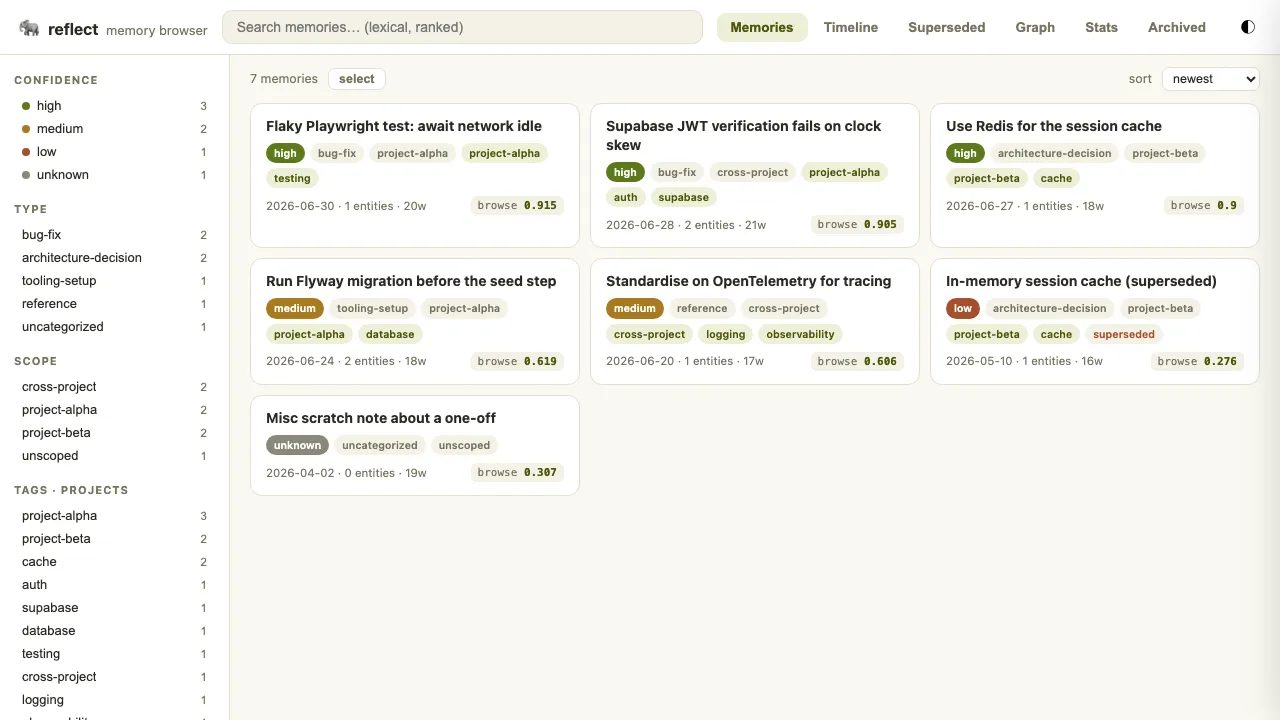
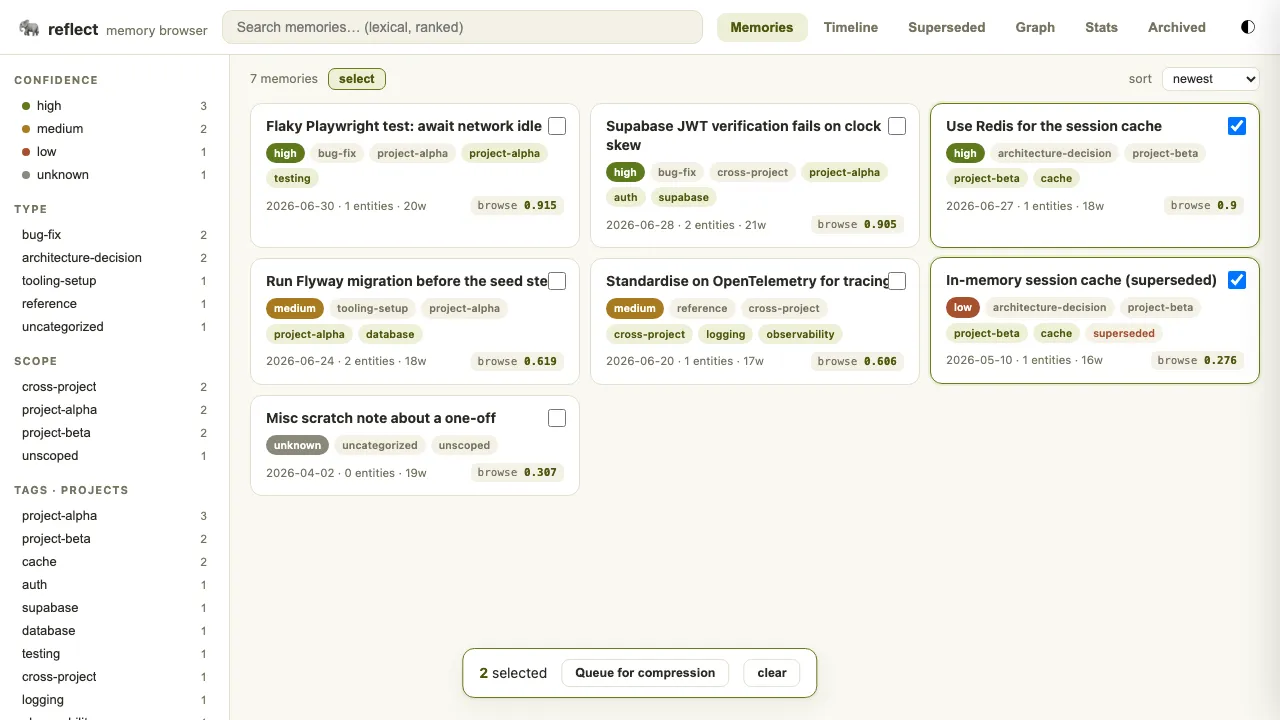
- Browse — a faceted memory list (confidence · type · scope · tags/projects), sortable by newest, computed recall score, or title.
- Search — lexical BM25 ranking; each result carries a match score and a browse-ordering score
(confidence × recency × tag overlap). This is a browse heuristic, not the recall reranker’s
score — the real reranker (see R2/R3 in the recall reference)
deliberately dropped exp-decay recency. Full semantic search stays on the
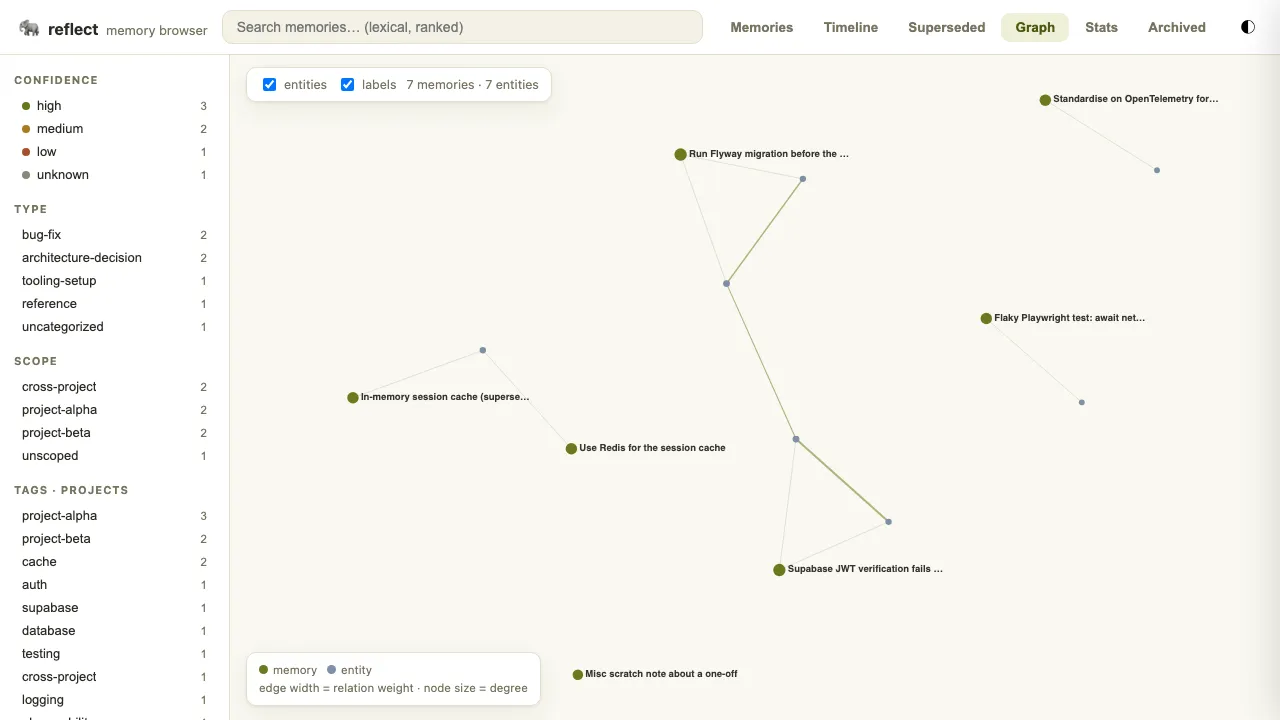
reflect searchCLI. - Graph — a two-layer force graph of memory and entity nodes; edge widths encode graphml relation weights. Toggle the entity layer, drag/pan/zoom, click a memory to open it.
- Timeline — memories grouped chronologically.
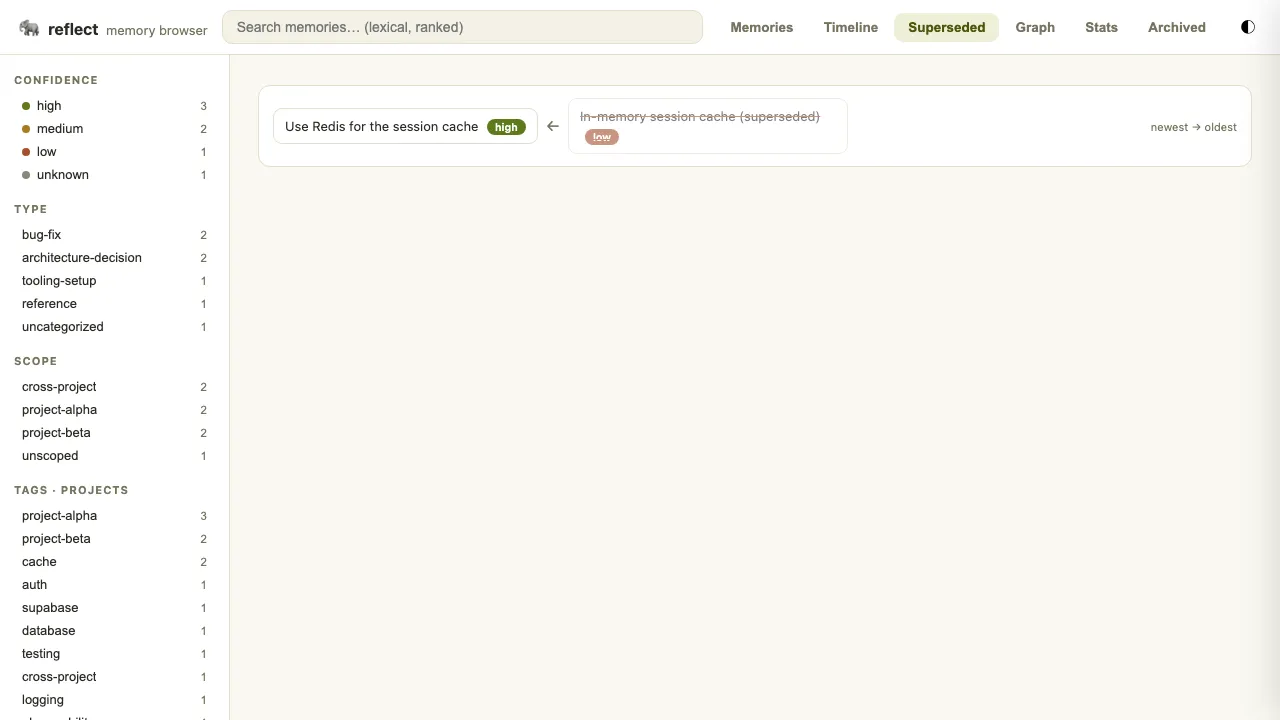
- Superseded —
superseded_bychains rendered newest tip to oldest ancestor. - Curate — soft-archive/restore (reversible, no hard delete), edit a note’s confidence, and
multi-select memories to queue a group for compression by the
/reflectconsolidate skill (written to a versionedcompress-queue.yaml— the web app never calls an LLM). - Stats — confidence/type/scope/tag distributions and engine-op usage counts.
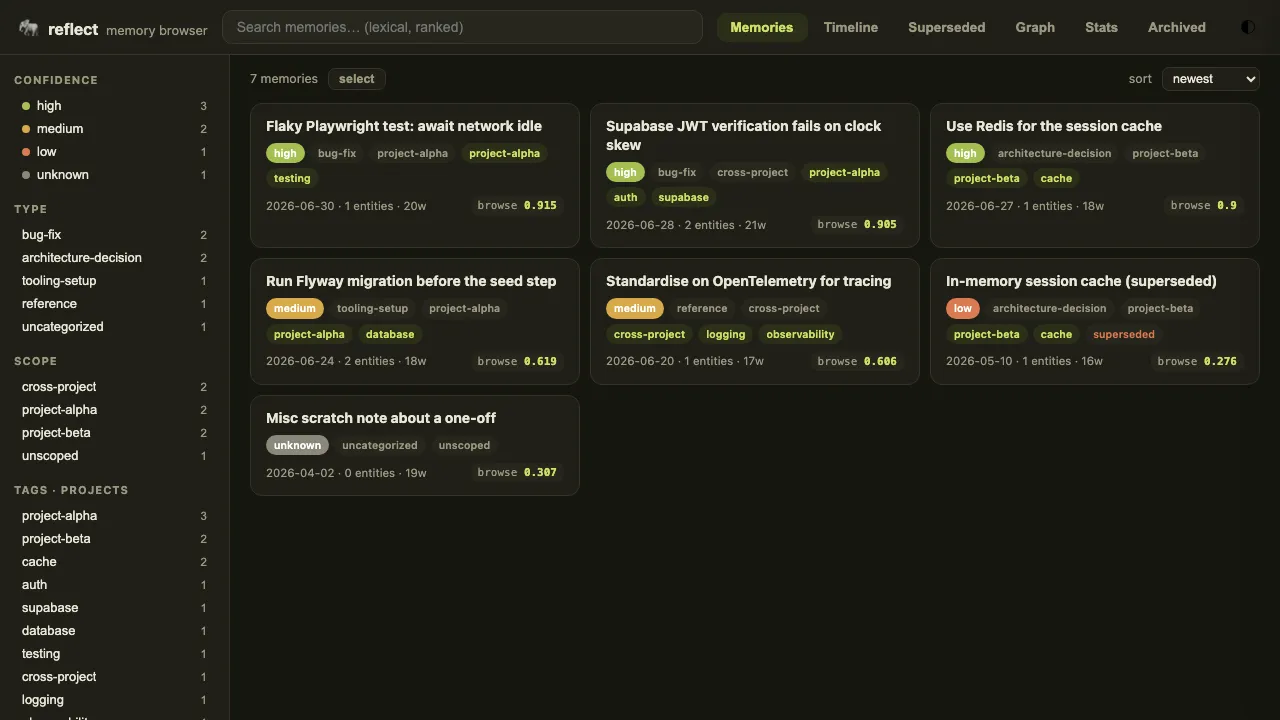
Light and dark themes throughout.
Weightages surfaced
| Weightage | Where |
|---|---|
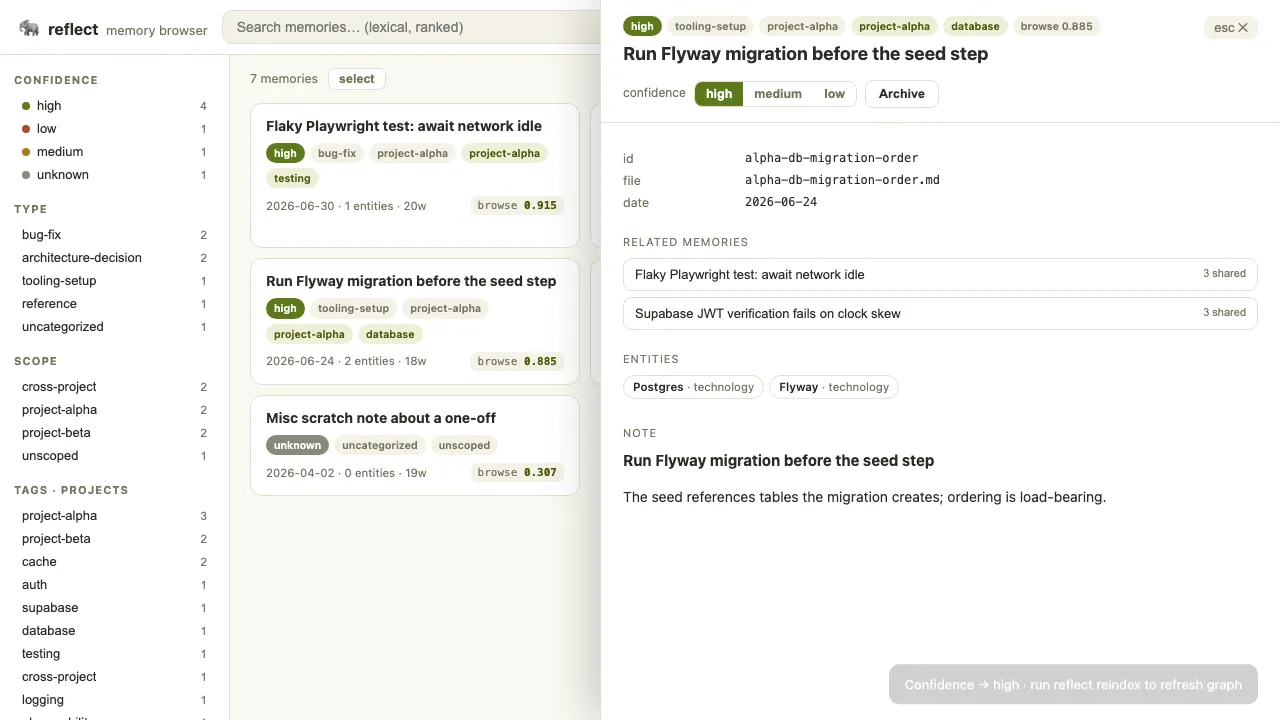
| Editable confidence | segmented control in the detail drawer |
| Computed browse score | on every card and in the drawer |
| Graph edge weights | edge width in the Graph view |
| Recall usage stats | engine-op counts in the Stats view |
Curation is metadata-only and file-first
Mutations edit the markdown note (the source of truth) and the browser view reloads immediately.
The nano-graphrag cache used by reflect search is not rebuilt synchronously — the engine
only supports a full-batch reindex — so after archiving or editing confidence, run
reflect reindex to refresh semantic search and the entity graph. The UI hints at this. Note
bodies stay agent-authored; only metadata is editable here. Postgres backends are read-only in
this release.
Soft-archive moves the note into an archived/ sibling directory. This is the browser’s own
reversible delete and is separate from the forget sweep’s .forgotten/ directory (see
A3 in the recall reference), which the sweep manages with its
own database accounting. Archiving here does not run the sweep or touch its records.
Loopback only — no authentication
Curation is guarded: the server rejects any request whose Host isn’t loopback (defeats
DNS-rebinding) and requires an X-Reflect header on mutations, so only the same-origin SPA can
drive them. There is no auth — do not bind a public interface. To reach it across your
tailnet, use the tailscale serve proxy shown above rather than exposing the port directly.
Screenshots
Source
src/reflect_kb/serve.py
and the e2e suite under
tests/e2e/ in
stevengonsalvez/ainb-reflect-memory. Full
guide: docs/reflect-serve.md.