

LOCOMO benchmark in full
This is the long form of the LOCOMO work. The Benchmarks page has the headline and a short method; this page has every stored run, how the harness works, which numbers are comparable and which are not, and how to re-run it. Retrieval stages referred to here are described in Retrieval styles, Retrieval features and the Recall pipeline.
Dataset
Section titled “Dataset”LOCOMO is a long-term conversational memory benchmark: multi-session dialogues between two people, each with a QA set. The harness reads locomo10.json (not vendored; downloaded at run time).
| Fact (checked against the downloaded file) | Value |
|---|---|
| Conversations | 10 (conv-26, conv-30, conv-41, conv-42, conv-43, conv-44, conv-47, conv-48, conv-49, conv-50) |
| QA pairs, all conversations | 1986 |
| Category 1 (multi-hop) | 282 |
| Category 2 (temporal) | 321 |
| Category 3 (open-domain) | 96 |
| Category 4 (single-hop) | 841 |
| Category 5 (adversarial, unanswerable) | 446 |
conv-26 (the pilot) |
19 sessions, 199 QA (32 multi-hop, 37 temporal, 13 open-domain, 70 single-hop, 47 adversarial) |
The pilot takes the first 10 questions of each category from conv-26, so open-domain is covered by 10 of its 13 questions.
Harness
Section titled “Harness”Location: tests/eval/locomo/.
| File | Role |
|---|---|
locomo_bench.py |
Ingest, recall, answer, judge, score. Resumable. |
make_report.py |
Render a results/report_<tag>.json into a markdown scorecard (no LLM). |
calibrate_judge.py |
Re-grade cached answers with several judge models, report agreement vs Opus. |
plot_locomo.py, plot_positioning.py |
Produce results/locomo_comparison.png and results/locomo_positioning.png. |
results/ |
Committed: report_pilot50*.json, judge_calibration_*.json, arm_thresholds_bge.txt, two PNGs. Ignored: results/kb/, results/cache/, logs. |
sessions ──▶ extract atomic notes (claude -p) ──▶ write .md into hermetic KB ──▶ reflect reindex --forcequestion ──▶ recall.py (the shipped script, --no-cache, --confidence ANY) ──▶ context ──▶ answer (claude -p, "answer only from MEMORY, else NOT MENTIONED") ──▶ judge vs gold (claude -p) ──▶ J-score- Only retrieval is the real engine. The dialogue to note step is a LOCOMO-specific extraction prompt inside the harness, because the shipped writer is tuned for coding transcripts. Notes are written as
documents/<session>-<n>-<slug>.mdwithcategory: conversation. - Hermetic state. Each conversation gets its own KB under
results/kb/and its ownREFLECT_STATE_DIR, so a run never touches~/.learningsor~/.reflect. - LLM calls go through
claude -p --setting-sources '' --strict-mcp-config --output-format json: clean model, OAuth login, no hooks, CLAUDE.md or MCP, no API key. - Adversarial scoring. For category 5 the gold answer is “NOT MENTIONED” and the judge accepts only a refusal.
- Recall subprocesses run in their own process group with a 90 s kill (the engine occasionally wedges),
--recall-concurrencydefault 3.
Configs
Section titled “Configs”| Config | What the answerer gets |
|---|---|
arms_on |
recall.py with every arm knob exported =1: RECALL_GRAPH_ARM, RECALL_CROSS_ENCODER, RECALL_MMR, RECALL_TEMPORAL, RECALL_TEMPORAL_ARM, RECALL_BITEMPORAL_EDGES, RECALL_FUZZY_CACHE, RECALL_FOLLOWUP, REFLECT_TIERED_INJECT |
arms_off |
recall.py with the same nine knobs exported =0 |
no_memory |
The question only (floor) |
full_context |
The entire conversation in the prompt (ceiling) |
recall.py reads each arm knob as os.environ.get(NAME, "1") != "0", so an unset knob is on. arms_off therefore has to export =0, not remove the variable. Two of the nine are inert inside this harness: REFLECT_TIERED_INJECT is a SessionStart hook knob (opt-in, default off, never read by recall.py), and RECALL_FUZZY_CACHE has nothing to act on because the harness passes --no-cache. The R8 bounded boosts, token economics and the opt-in R7/R12 gates are not arms and are identical in both configs.
python3 locomo_bench.py --print-config prints the effective env per config without touching data or a model, and fails if a listed knob is not read by the engine. tests/test_locomo_arms_off.py proves over a toy KB and a fake engine CLI (no model, no API) that arms_off retrieves differently from arms_on and that each knob changes behaviour on its own. The verdict cache is keyed on the effective arm env, so a verdict cached under the old behaviour is never reused.
| Flag | Default | Purpose |
|---|---|---|
--samples |
0 |
Comma list of conversation indexes (0 to 9) or all |
--configs |
all four | Subset of the configs above |
--per-cat N |
none | First N QA of each category (balanced pilot) |
--limit-qa N |
none | First N QA overall (smoke test) |
--recall-limit |
8 | Top-K notes retrieved. The biggest lever on multi-hop. |
--recall-max-chars |
3000 | Characters of memory injected |
--recall-concurrency |
3 | Parallel recall.py processes (RAM bound) |
--concurrency |
8 | Parallel claude -p answer/judge calls |
--answer-model |
sonnet |
Answerer |
--judge-model |
sonnet |
Judge. Use opus for the reference figures. |
--tag |
pilot |
Names the report file and scopes the verdict cache |
Extraction results and per-QA verdicts are cached under results/cache/ (verdicts scoped by --tag), so an interrupted run resumes.
Each results/report_pilot50*.json is one stored run. Scores below are j_score as stored (overall) with per-category values, all on the same 50 questions. n_notes is the number of memory notes the extraction produced. Cost is total_cost_usd for answering plus judging that config.
The report files record the answerer ("model": "sonnet") but not which judge graded them. The README and REPORT attribute the B and D rows to the Opus judge and the earlier rows to Sonnet; the table follows that attribution.
| Tag | What changed | n_notes | Recall budget | Config | single | multi | temporal | open | adv | overall | cost |
|---|---|---|---|---|---|---|---|---|---|---|---|
pilot50 |
baseline | 239 | top-8 / 3000 chars | arms_on | 0.5 | 0.1 | 0.5 | 0.5 | 1.0 | 0.52 | $6.67 |
| arms_off | 0.4 | 0.2 | 0.5 | 0.5 | 1.0 | 0.52 | $3.80 | ||||
| no_memory | 0.0 | 0.0 | 0.0 | 0.0 | 1.0 | 0.20 | $5.27 | ||||
| full_context | 0.9 | 0.8 | 0.6 | 0.2 | 0.9 | 0.68 | $11.48 | ||||
pilot50_tuned |
bigger recall budget | 239 | top-25 / 10000 | arms_on | 0.5 | 0.5 | 0.5 | 0.4 | 1.0 | 0.58 | $5.26 |
| arms_off | 0.5 | 0.5 | 0.5 | 0.5 | 1.0 | 0.60 | $2.13 | ||||
pilot50_v2 |
exhaustive extraction (mpnet embedder) | 635 | top-25 / 10000 | arms_on | 0.6 | 0.5 | 0.6 | 0.5 | 0.9 | 0.62 | $5.72 |
| arms_off | 0.6 | 0.5 | 0.7 | 0.5 | 0.9 | 0.64 | $1.66 | ||||
pilot50_B |
bge embedder and reranker | 635 | top-25 / 10000 | arms_on | 0.8 | 0.7 | 0.8 | 0.6 | 0.8 | 0.74 | $8.27 |
| arms_off | 0.7 | 0.8 | 0.8 | 0.6 | 0.8 | 0.74 | $3.23 | ||||
pilot50_D |
B plus HyDE | 635 | top-25 / 10000 | arms_on | 0.8 | 0.8 | 0.8 | 0.7 | 0.9 | 0.80 | $7.96 |
| arms_off | 0.9 | 0.8 | 0.7 | 0.7 | 0.7 | 0.76 | $7.23 | ||||
pilot50_ALL |
D plus abstention gate (min-overlap 0.15) |
635 | top-25 / 10000 | arms_on | 0.3 | 0.0 | 0.7 | 0.2 | 1.0 | 0.44 | $8.37 |
| arms_off | 0.2 | 0.0 | 0.7 | 0.2 | 0.9 | 0.40 | $6.31 |
The best-config 50-question run (pilot50_D, both configs) cost about $15, matching REPORT.md.
Read each arms_on / arms_off pair as two noisy samples of the same retrieval (see the caution above), not as an ablation.
Reading the table:
- No memory scores 0.20, all from adversarial. The base model cannot answer anything else, so memory is doing the work.
- Full context scores 0.68 under the baseline-era judge, with open-domain at 0.2. The later 0.80 is under a different judge (Opus), so the two are not directly comparable.
- Recall budget is the first lever. Going from top-8/3000 to top-25/10000 lifted multi-hop from 0.1 to 0.5 (
arms_on0.1 to 0.5,arms_off0.2 to 0.5; both ran the same retrieval, so the two columns are repeat samples). - The abstention gate was a regression, see below.
Opus-judged headline table
Section titled “Opus-judged headline table”This is the table in the README and REPORT. Rows for B and D equal the stored arms_on rows above. The first row is different: it is the Opus re-grade of the pilot50_v2 answers (100 answers, arms_on and arms_off pooled, from judge_calibration_pilot50_v2.json), which is why a per-category cell can read 0.75 on 10 questions. The committed files hold only its overall figure (0.73).
| Config (Opus judge) | single | multi | temporal | open | adv | overall |
|---|---|---|---|---|---|---|
| v2: mpnet + exhaustive extraction | 0.70 | 0.75 | 0.80 | 0.50 | 0.90 | 0.73 |
| + bge embedder/reranker (B) | 0.80 | 0.70 | 0.80 | 0.60 | 0.80 | 0.74 |
| + HyDE query expansion (D) | 0.80 | 0.80 | 0.80 | 0.70 | 0.90 | 0.80 (best) |
| + abstention gate (F, min-overlap 0.15), dropped | 0.30 | 0.00 | 0.70 | 0.20 | 1.00 | 0.44 |
The 0.73 to 0.80 comparison therefore mixes a pooled 100-answer figure with a single-config 50-answer figure. The B and D rows are the cleaner pair.
Judge calibration
Section titled “Judge calibration”calibrate_judge.py re-grades already-cached answers with each judge, isolating the judge effect.
| Answer set | n | Haiku | Sonnet | Opus (reference) |
|---|---|---|---|---|
pilot50_v2 |
100 | 0.53 | 0.65 | 0.73 |
pilot50_D |
100 | 0.59 | 0.70 | 0.77 |
On pilot50_v2, agreement with Opus was 0.80 for Haiku (it rejected 20 answers Opus accepted and none the other way) and 0.92 for Sonnet (8 and 0). Cheaper judges are one-directionally harsh toward valid paraphrases and date formats, not randomly noisy. Judge choice alone moves the headline by about 0.20, more than any single engine change, which is why every headline figure uses the Opus judge.
Engine changes tried
Section titled “Engine changes tried”Each change was an additive, env-gated edit. Defaults were left alone, and none needs a new API key. “Code today” is where the knob lives in this repo.
| Fix | Knob | Result | Verdict | Code today |
|---|---|---|---|---|
| A. recall budget | REFLECT_RECALL_LIMIT (default 10), REFLECT_RECALL_MAX_CHARS (default 2000) |
multi-hop 0.1 to 0.5 | keep | recall.py DEFAULT_LIMIT, DEFAULT_MAX_CHARS |
| B. stronger embedder and reranker | REFLECT_EMBED_MODEL=BAAI/bge-base-en-v1.5, REFLECT_CE_MODEL |
single-hop 0.70 to 0.80, open 0.50 to 0.60, overall +0.01 | keep | model_daemon.py (EMBEDDING_MODEL_NAME, cross-encoder name); dimension derived from the model, a swap needs a fresh reflect reindex |
| C. per-arm threshold recalibration | RECALL_ARM_{VECTOR,BM25,GRAPH,TEMPORAL}_MIN_SCORE |
neutral | keep | recall.py --calibrate-thresholds, CALIBRATED_FLOORS |
| D. HyDE query expansion | REFLECT_RECALL_HYDE=1 |
multi-hop 0.70 to 0.80, open 0.60 to 0.70, adversarial 0.80 to 0.90, overall +0.06 | keep, the big win | recall.py _hyde_expand |
| F. abstention / OOD gate | REFLECT_RECALL_MIN_OVERLAP (0.15) |
answerable QA fell to 0.44; 27 of 50 answers became NOT MENTIONED vs 12 of 50 | dropped at 0.15 | recall.py --min-overlap; SessionStart uses 0.2 |
| G. conversational extraction | harness adapter | inside the 0.52 to 0.64 gain | follow-up: port to the real writer | locomo_bench.py EXTRACT_SYS only |
Calibrated floors saved with the run (results/arm_thresholds_bge.txt, 40 sampled docs, 10th percentile; vector n=800, BM25 n=0): vector 0.167, BM25 0.15, graph 0.0 (open), temporal 0.05. The BM25 sample size of 0 means the lexical arm was not exercised in the calibration environment, which fits QMD not being installed there. That is an inference, not something the report states.
HyDE reuses reflect’s own headless claude -p (model from REFLECT_DRAIN_MODEL, default sonnet, 60 s timeout), generates one invented answer sentence, and appends it to the query. A failure falls back to the raw query. It adds one model call per recall (about $0.02 per question in REPORT.md) and is off by default.
The REPORT text says the arm-threshold step is reflect calibrate-thresholds. There is no such reflect subcommand in this repo; the entry point is python3 plugin/skills/recall/scripts/recall.py --calibrate-thresholds.
Were the 4.1.0 arms positive?
Section titled “Were the 4.1.0 arms positive?”Unknown. An earlier REPORT section 4 concluded the arms turned positive with bge and HyDE (arms_on 0.80 vs arms_off 0.76). That pair came from identical retrieval, so the +0.04 is noise and the conclusion has been withdrawn in REPORT.md. What the data does support: the arms were on in every stored run, and the stronger embedder plus answer-shaped queries are what moved the score. At n = 50 a delta under about 0.1 is not resolvable even with a correct ablation, so treat the re-run as a first look and repeat it (or use more conversations) before drawing a conclusion.
Where reflect sits
Section titled “Where reflect sits”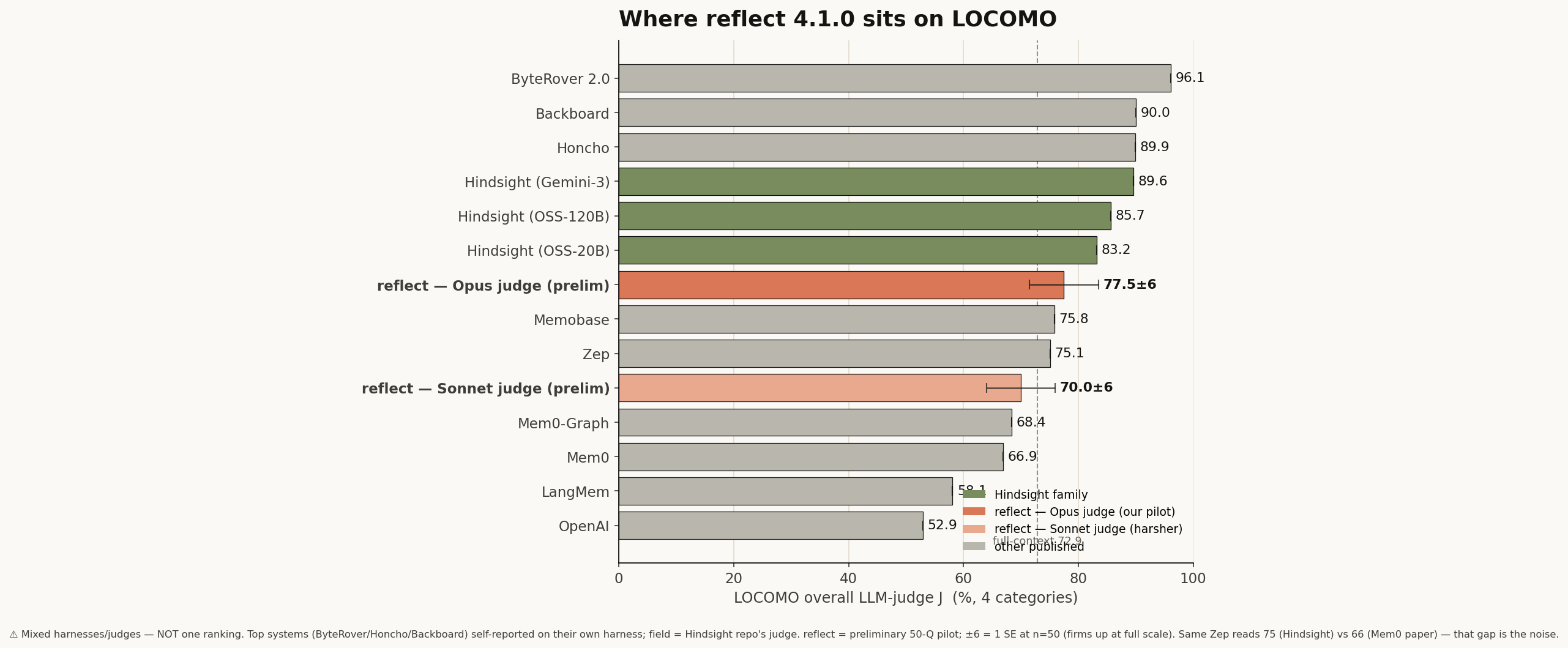
Values as plotted by plot_positioning.py (LLM-judge J, percent, 4 categories):
| System | Score | Note |
|---|---|---|
| ByteRover 2.0 | 96.1 | self-reported, own harness |
| Backboard | 90.0 | self-reported |
| Honcho | 89.9 | self-reported |
| Hindsight (Gemini-3) | 89.6 | Hindsight repo |
| Hindsight (OSS-120B) | 85.7 | Hindsight repo |
| Hindsight (OSS-20B) | 83.2 | Hindsight repo |
| reflect, Opus judge | 77.5 | pilot, plotted as +/-6 (about 1 standard error at n=50) |
| Memobase | 75.8 | Hindsight repo |
| Zep | 75.1 | Hindsight repo (the Mem0 paper reports about 66) |
| reflect, Sonnet judge | 70.0 | pilot |
| Mem0-Graph | 68.4 | |
| Mem0 | 66.9 | |
| LangMem | 58.1 | |
| OpenAI | 52.9 |
How to read it:
- 77.5 is the 4-category mean: (0.80 + 0.80 + 0.80 + 0.70) / 4 over single, multi, temporal and open-domain, leaving out adversarial as most published numbers do. An earlier README said 76.2 and an earlier REPORT.md said “about 0.76”; both were arithmetic slips, corrected (the README in commit
1df981337, REPORT section 5 afterwards) to 0.775. - The two reflect bars are not on the same basis. The Opus bar is the 4-category mean. The Sonnet bar (70.0) matches the 5-category pooled overall in
judge_calibration_pilot50_D.json(0.70, Sonnet), so it includes adversarial. - Harnesses and judges differ across the field (the same Zep reads 75 on one harness and about 66 on another), so this is directional placement, not a ranking. reflect lands mid-field, on par with Memobase and Zep and above Mem0; the newest systems score higher but are self-reported.
- The dashed “full-context 72.9” line in the chart has no source recorded in this repo. The stored
full_contextrun scored 0.68 over five categories.
For a feature comparison of these systems see Comparison.
Reproduce
Section titled “Reproduce”Run from the repo root. The harness looks for the venv at .venv-locomo/ in the repo root and for plugin/skills/recall/scripts/recall.py; both paths were checked against locomo_bench.py.
# 1. dedicated venv with this checkout's reflect (the harness puts its bin/ on PATH)uv venv .venv-locomo --python 3.12UV_TORCH_BACKEND=cpu VIRTUAL_ENV=$PWD/.venv-locomo uv pip install -e ".[graph]"
# 2. dataset (not vendored; the directory must exist first)mkdir -p tests/eval/locomo/datacurl -sL https://raw.githubusercontent.com/snap-research/locomo/main/data/locomo10.json \  -o tests/eval/locomo/data/locomo10.json
# 3. stratified pilot, 10 QA per category, conversation 0 (conv-26)cd tests/eval/locomopython3 locomo_bench.py --samples 0 --per-cat 10 --tag pilot
# best config: bigger budget, bge embedder, HyDE, Opus judgeREFLECT_EMBED_MODEL=BAAI/bge-base-en-v1.5 REFLECT_RECALL_HYDE=1 \  python3 locomo_bench.py --samples 0 --per-cat 10 \  --recall-limit 25 --recall-max-chars 10000 --judge-model opus --tag tuned
# re-grade cached answers with several judgespython3 calibrate_judge.py --tag pilot50_D --judges haiku,sonnet,opus
# effective arm env per config (no data, no model); arms_on all =1, arms_off all =0python3 locomo_bench.py --print-config
# re-run the arms ablation with the fixed harness (about $15, Opus judge).# Use a NEW tag; extraction is cached and reused.REFLECT_EMBED_MODEL=BAAI/bge-base-en-v1.5 REFLECT_RECALL_HYDE=1 \\  python3 locomo_bench.py --samples 0 --per-cat 10 \\  --recall-limit 25 --recall-max-chars 10000 --judge-model opus \\  --configs arms_on,arms_off --tag pilot50_D_armsfixpython3 make_report.py results/report_pilot50_D_armsfix.json REPORT_armsfix.md
# render a scorecard from any stored or new report (works offline)python3 make_report.py results/report_pilot50_D.json REPORT.md
Full benchmark (--samples all, 1986 QA across the configs) is about $1k and hours, per REPORT.md; it has not been run.
What was and was not verified for this page: the dataset URL returns 200 and the structure and counts above were read from the file; make_report.py renders the stored report_pilot50_D.json offline; every flag in the table was read from parse_args. The model-calling steps (locomo_bench.py runs, calibrate_judge.py) were not executed here because they spend model budget; --print-config and tests/test_locomo_arms_off.py spend none and were run. The exact REFLECT_CE_MODEL value used for fix B (the REPORT says a bge reranker) is not recorded in the repo, so the command above leaves the cross-encoder at its default.
Caveats for any reproduction:
- Extraction prompt. The committed
EXTRACT_SYSis the exhaustive one (635 notes). The 239-note baseline extraction prompt is not preserved, so the first three rows of the runs table cannot be regenerated exactly. - Wall time. Each
recall.pysubprocess reloads its models unless the model daemon (5.2.0+) is warm, so recall time depends on the version. The latency fields in the stored report files are inconsistent (recall and answer p50 are swapped in some files), so they are not quoted here. - Single conversation. Per-cell noise is about +/-0.1. The F regression and the D gain exceed that; the +0.01 overall from B does not (its per-category gains are within noise too).
- Judge. Pass
--judge-model opusfor numbers comparable to the headline. The default (sonnet) grades about 0.07 lower.